The world before words
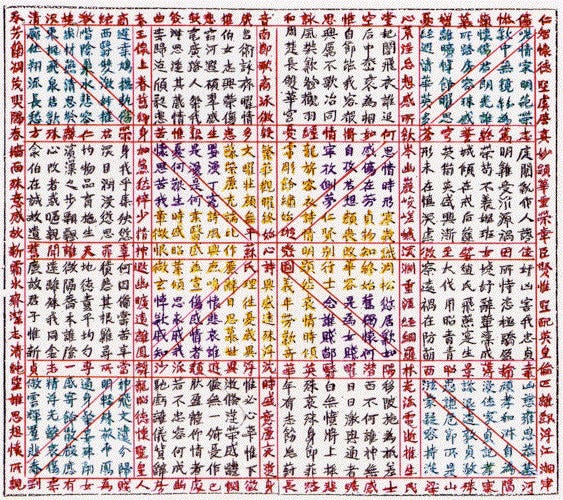
Sui Hui’s Star Gauge Poem - it can be read in different directions to generate over 3,000 different poems.
There was a moment this spring when language broke down for me. I had been inside for weeks, barely capable of moving from the couch to the bathroom on my own, unable to walk more than the few steps it took to go from the apartment building door to the seat of the Uber without my mom’s steady arm. Too tired to think. Too tired to speak.
It was almost Easter, and my mom had gotten a wheelchair ahead of the holiday, hoping the family could take me for a walk in Central Park. She pulled it out of the car one afternoon to wheel me around Midtown East near the hospital, not an area known for its beauty, but the shock of being outside after so long inside, of seeing the bright blue sky, the whisper of cherry blossoms peaking through the scaffolded sidewalks brought me to tears. I can’t quite put into words the glory of it, the divinity, the otherworldly beauty of this unbelievably mundane scene. It was a moment of rebirth, of being a child again in an alien world.
Since then, I’ve been searching for what it looks like to live in that space without naming it. To see things as they are, without filtering them through meaning.
I recognize the irony. I write to make sense of the world, which I inherently know is uncapturable, uncontainable, beyond the reach of sense. How do you write not to explain, but to hold space for the indescribable?
A name for anything carries deep, and often unconscious, meaning and weight, Alexander Jodorowsky said. It’s the assignment of an abstract concept to form, of a pre-determined destiny. But, what is a world without names? It is only the seeing, the raw encounter with the world you’ve never seen before because you have never seen it without the burden of accumulated meaning, without the filter of everything you’ve thought and had been taught to believe about cherry blossoms and spring.
In that moment, there is no destiny, because there was no future, no past, no narrative, just the eternal presence of the cherry blossoms existing, and you existing with no concepts to separate you.
Last year, I took a drawing class at 23rd Street Studio taught by the brilliant Michael Markowitz. Out of respect for his methods, I won’t say too much, but for twenty weeks, ten of which were spent drawing without looking at the page, I unlearned what I thought I knew. “Draw the essence,” he coached, “Don’t draw the form.”
By reverting to pattern, to known form, you rob yourself of the experience of impermanence. The arm is not an arm, it is a collection of light and shadow, of shapes and values. This arm, in this light, at this moment, has never existed before and will never exist again.
In the words of Wordsworth, “we half-perceive and we half-create,” by the function of you looking at the world, you create the world. It is a dynamic dance between the seer and the seen. Merleau-Ponty writes about this as “the chiasm”, this intertwining, this realization shared by artists and quantum physicists that the observer affects the observed.
In the world of psychedelics, there is always a fear of going too far, of seeing too much, of touching reality without its protective skin of form. It can drive people mad because we aren’t built to live in pure perception. Form keeps us safe, names enable us to live.
I think about Greek dramas, how the words of the gods could only be comprehended after they had been echoed and repeated by the chorus. Language stands between us and the searing brightness of the truth, translating the unbearable and inconceivable into something human.
Every religion grasps at this through story, but falters. Naming inherently creates division due to preconceived filters. We are, but Babel, aligned in our truth, but separated by our words. The Tao that can be spoken is not the eternal Tao. As soon as you name something, you’ve lost it.
My mind keeps drifting back to the Telepathy Tapes, to the recordings of nonspeaking autistic children who, by virtue of their separation from language, access a pervasive layer of unity consciousness. What does it feel like to hear the world, to hear others’ thoughts, without the linguistic bounds that make us feel separate?
I’ve never been good with languages. I realized a couple of years ago that it’s because I kept trying to speak Spanish while looking at an English world. The words you use shape your experience of the world; each language carries different colors, different textures. I’m not linguistically adept enough to know, but I often think about what it would be like to filter between these views. To see the world as context-dependent in Japanese, to see time flowing backward in Aymara, to see relationships gendered in French, the world endlessly combinable in German. How do you reconcile these views?
Even within a single language, there are countless ways of seeing. I’ve always been fascinated by Chinese poetry; my interest initially piqued from the genre of reversible poems, poems that can be read and interpreted forwards and backward. To quote Weinberg in Nineteen Ways of Looking at Wang Wei in his exploration of one simple Taoist poem, “each version makes visible another aspect of the original, but none contains it.”
My mind drifts constantly back to the core of Zen Buddhism, the Heart Sutra, Gate gate pāragate pārasaṃgate bodhi svāhā. Gone, gone, gone beyond, gone utterly beyond, awakening. To empty your mind of form so that you can truly see.
Last week, a family friend with ALS wrote me a letter with his eyes, and I thank him profusely for sending me down this particular rabbit hole. What does it mean to write with your eyes? To see so deliberately, so clearly, that seeing becomes creating.
Form is emptiness, emptiness is form. I write this to you with my eyes, and you create it through yours, both of us seeing the world into being, the one before language taught us we were separate.
Gone, gone, gone beyond. Gone utterly beyond.
Awakening.