Learning to taste again
A few days ago, I showered for the first time without fear of my hair falling out. It happened before I consciously realized it, the dab of shampoo in my hand, the liquid foaming on my head. I froze once I had realized what I had done, terrified that my hands would be filled with my strands. Yet, as the water rained over my head, my hair intact, I felt like Natalie Portman in V for Vendetta, emerging into the storm. Broken but victorious.
I wept from the strangeness of return. From the terror of starting anew. From the defiant choice to love this life anyway, knowing how quickly it could disappear again.
I stood there rubbing the strands between my fingers, staring at the precipitation forming on the glass door, and wished I could tell my past self to stop gripping so hard. That my hair may fall out again, but it will grow back. That life comes again, despite loss, because of loss.
I’ve been thinking a lot about what life looks like after you’ve been cracked open, be it illness, death, injury, heartbreak, or a freak accident. There’s an irreversible change that occurs, a split in your center of gravity and orientation. It’s as if you were jolted awake from a dream without realizing you were asleep, layers and layers of consciousness unraveling like an onion.
How do you go back when something like that happens? How do you deal with the minutiae of taxes, of PowerPoint presentations, of parties you should go to but don’t feel like it, of all of the obligations you agreed to before you saw the void of existence?
It can be an overwhelming dissonance. A cosplay of attempting to be a real person living a real life, unburdened by existential doubts. In crisis, you have a singular mission of survival, or caring for the person you may lose, of repairing what may be broken. But once the dust settles and you are birthed back into the bright light of harsh and beautiful reality, it’s a destabilizing question of what’s next.
In the book, Transitions, William Bridges calls it the neutral zone, the liminal space between the ending you didn’t choose and the beginning you can’t quite yet see. It’s the moment of gestation of a seed in the dirt, darkness, but a fertile void of creativity if you let it be.
It’s like taking a soup off the heat, when everything rises, and you can see what isn’t essential. You can skim the excess off as it cools, leaving the remains clearer and more concentrated.
The old identity has died, but the new has not yet emerged. You are not who you were. You are not who you will become. The pot simmers, ready to be tasted.
I’ve been traveling continuously for the last few weeks; in some way, it’s easier for me mentally to match my inner state. I miss home, but my desire to float has superseded all logic and grounding. I seek fluidity, a deep desire to see the world, to taste, smell, touch, be.
And in my travels, out of convenience near my treatment in Germany, I’ve found myself drifting back to Italy, a place I swore years ago I would never go back to due to accidents and injuries. I am in the Eat phase of Eat Pray Love. My taste buds are back, and I just want to devour the world.
As I emerge from a crack in the ground, shaking off the layers of trauma that had buried me, I taste everything for the first time.
I had always wanted to have children so I could experience the world anew through their eyes, but in my loss of fertility from treatment, I have fulfilled that wish myself. There’s a manicness to it, an overwhelm of newness. Every sunset and sunrise feels like my first, the colors and sensations more vibrant than I can fathom to explain. I am grateful for every minute, the good and the bad, every travel delay, every inconvenience, every point of exhaustion.
And, in this whirlwind, I pause. I feel like an alien in a foreign world, examining from the outside, cautiously stepping in. How do you go back knowing it could break again?
My waiter the other day said that Italians were only good for art, food, wine, and to forget the rest. I laughed when he said it, thinking what a way to live, and then wondered if that wasn’t the point. To love the fleeting, the folly, the things you know you will lose but that you say yes to anyway.
Cancer hasn’t shrunk my life. It has skimmed it.
His comment stayed with me, and against every instinct, I am learning that life doesn’t need to be hard. I can be held without bracing for the fall. I can sleep. I can make space for what I love. I can live easily, beautifully, leisurely, like an Italian, savoring each moment of the day. A life doesn’t need to be big to be beautiful.
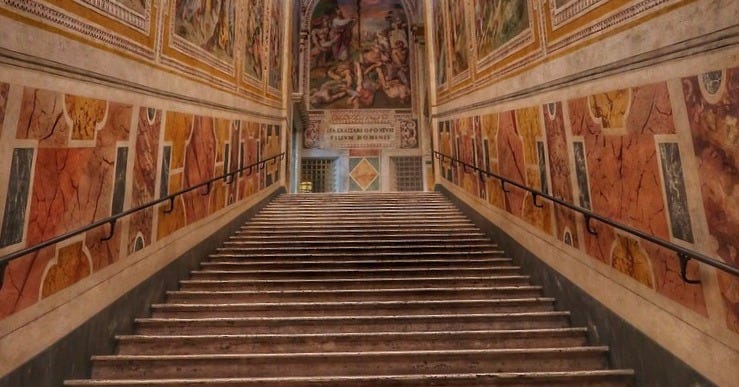
I went back to the Scala Santa a couple of days ago as part of a pilgrimage to places that have shaped me. It houses the stairs Christ climbed to the cross. You can only climb it via your hands and knees, the posture of ultimate surrender.
I thought about the woman who climbed it years ago and who I was now. I thought about who I was meant to become. Life is learning and unlearning, layering and shedding, a spiral that looks like progress but really is a return. Past, present, and future converge on each step into a unified being.
At the top, I stared eye to eye with the skull at the base of the cross. I realized the question was never about living or dying, but finding peace in my soul. While I am here, I want to taste it all.
I don’t want a single thread of truffle tagliatelle to go to waste.
Sending so much love to you all! Thank you, as always, for reading and sharing my words.
If you relate, I would love to hear how you’re learning to live, love, and taste again.