And how to live now
I’ve been thinking a lot about time lately. It comes from questioning how I best spend my limited time, but also what time fundamentally is.
It is almost Thanksgiving, but my body still feels like it’s February. I rationally know that time hasn’t stood still, seasons have changed, strangers have turned to friends, leaves and my hair have shifted state and fallen, and cities have imprinted themselves on me. Yet I am swimming in two currents at once, surface water moving forward while deeper water holds me in place. I met a man in Kenya years ago who didn’t know his own birthdate, who didn’t know how old he was, but could tell me the exact timing of the great migrations and rainfalls. I think about that now, as I’ve lost the ability to articulate any external marker of time. I can tell you the rhythm of my body in detail, how the seasonal wind has shifted, the changing colors of the flowers, but the months escape me.
I’ve been living, laughing, loving, traveling, surviving, but some subterranean part of me is still standing in the same month when I received my first diagnosis. It’s not trauma exactly. I no longer feel a disorienting pull towards the past, a shift in my nervous system, but rather, it marks the moment where I no longer could see my life on a linear timescale, when I realized that all timelines exist in unison. Nothing ever ends; it just changes form. In the words of T.S. Eliot, “Time present and time past are both perhaps present in time future”.
And from this fractured place, I keep asking: ‘Will I be okay?’ Or rather, ‘Can I live before I know?’ Can I belong to my future before I have proof? Can I choose meaning before the stakes feel low enough?
I’m sitting in the hospital, about to receive my last chemotherapy infusion of this cycle today, but unfortunately, likely not my last ever. My fourth therapeutic vaccine is on Thursday, as my Thanksgiving celebration, and I find myself back in the uncomfortable and familiar spot of thinking about what’s next. I think about my body’s survival the way I think about securing corporate systems from cyberattacks, hopeful that my defense systems are strong enough to prevent compromise, but focused on the second-order impacts of resiliency and recovery. In the case of a breach or recurrence, reaction time and response are crucial. I’ll get scans in mid-December to see if this worked, then move forward with the next phase, a T-cell therapy manufactured from my own cells that could be reinfused early next year. I hope for complete remission, but I am profoundly at peace either way. My life will never be over, even if I am not physically living it in this world.
I’ve been daydreaming about future plans, about future dreams, about the future lives I want to live. I find myself returning to a familiar turn of phrase, one of deference. I will do that when I’m healthy. I will do that when I am working again. I will do that when I have time. I will do that when I have accomplished X. I will do that when I have a partner to do that with.
I think it’s superstition, a belief that desire must be earned, that wanting too soon invites punishment, that joy is safest once delayed. Tomorrow only becomes real once we are perfect enough to deserve it.
What does it mean to live now? What does it mean to feel like you’ve made it far enough in life to pursue your dreams without consequence? What is the threshold you have to cross to move away from following in others’ footsteps to creating your own?
We’re looking for the feeling that everything will be okay in the ontological sense, to live the way that children race into the ocean, without bracing, without bargaining, with complete trust that if you fall, the water will hold you. We wait for safety to live, when the uncomfortable truth might be that living is the very thing that produces safety. As Kierkegaard wrote, “To dare is to lose one’s footing momentarily. Not to dare is to lose oneself.”
Family friends gave me a card and gemstone before my last treatment cycle, with a line from John O’Donohue that hasn’t left my side since: I would like to live / like a river flows. Carried by the surprise / of its own unfolding.
Perhaps the threshold of selfhood isn’t just achievement, stability, or health, but learning to flow, learning to unfold, to stop negotiating your aliveness with the universe.
I think about Thanksgiving and the ritual of giving thanks for everything in our lives. Gratitude lists only what has already arrived; longing reveals what the psyche is willing to live for. If time moves in currents rather than lines, there is no moment to wait for, only moments to inhabit. And this is one of them: February pressed against November, fear pressed against desire. I think of Beckett’s Cascando, and I find myself
_terrified again of not loving of loving and not you of being loved and not by you of knowing not knowing pretending pretending_
The deepest gratitude might be wanting something enough to risk not getting it. To reach for the future while standing in February, to live in November while carrying every month that came before. Not waiting for time to become linear again, but learning to inhabit all of it at once.
How To Live Now
Thank you so much for reading. I would be forever grateful if you passed this along to friends or family, if any of this resonates with you. It means the world to me to know I have a voice during this period of my life.
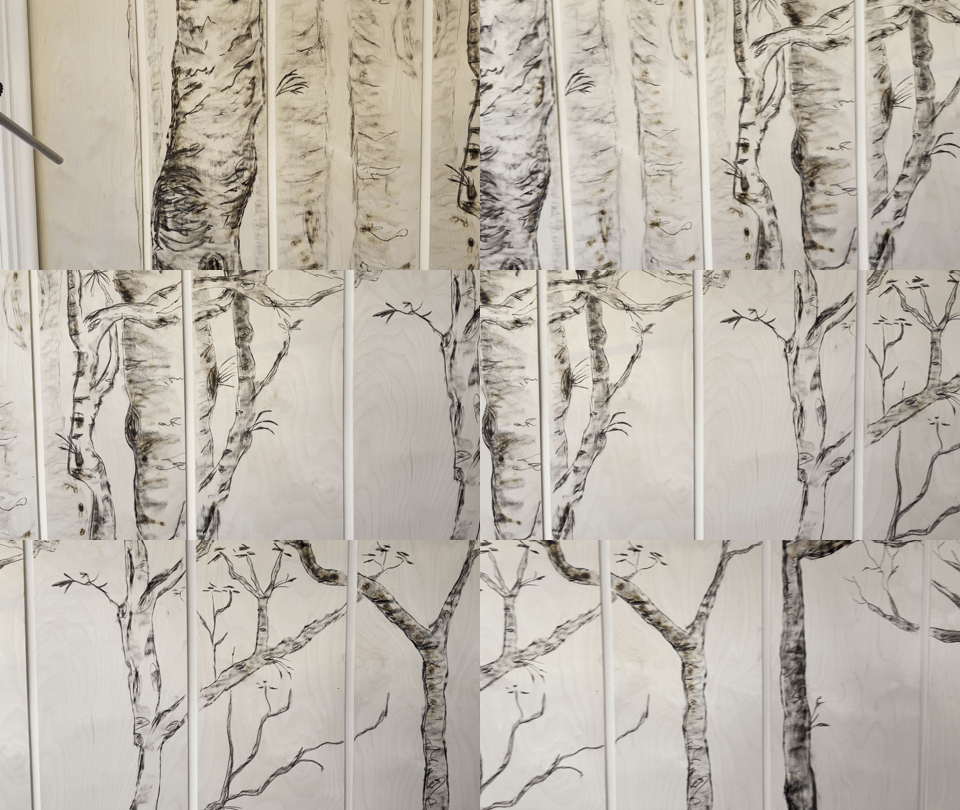
I’ve been thinking a lot about the idea of parallel lives, how our lives splinter into trees with each event or decision, and the versions of ourselves we could be. It comes from this idea of waiting, of knowing that there is a version of you who could be fulfilling your dreams. It’s easy to see where others have strayed, but harder to be intellectually honest with ourselves.
I like to think that somewhere out there, our parallel lives are waiting for us to visit. This doesn’t require a complete overhaul; you don’t have to quit everything and move to another country. Parallel lives are invitations.
So, in honor of my new Thanksgiving tradition, not just gratitude for what exists but gratitude for what my psyche still wants, the eros and desires that keep me alive, I’m choosing to visit parts of me I’ve long postponed.
If you’re gathering with people this week, consider asking: what are you still longing for? What would you do if you knew your time was short? It might be a more honest conversation than the usual gratitude list.
Here are some suggestions for you based on the parts you may long for most:
* If you long for the creative you:
* Make something badly on purpose. Revisit something you loved at 7, 12, or 19.
* If you long for the open-hearted you:
* Write down what you actually want from love, without minimizing. Accept a compliment without deflecting.
* If you long for the powerful you:
* Say no without apologizing. Do the thing you’ve been avoiding because it feels too big.
* If you long for the free you:
* Go somewhere with no plan and follow curiosity. Book the trip before you feel ready.
* If you long for the soft you:
* Let someone take care of you in one specific way. Rest before you deserve it.
* If you long for the embodied you:
* Wear something that feels good on your skin, even if no one sees it. Eat something slowly and with full attention.
* If you long for the intellectually alive you:
* Read something out of pure pleasure. Take notes like a student on purpose.
* If you long for the spiritually connected you:
* Sit in silence for 10 minutes before you check your phone. Create one tiny ritual that only means something to you.
What parallel life are you visiting this Thanksgiving? I’d love to know.